DIA’s 2026 assessment describes traditional orbits as crowded, contested, and increasingly targeted, and it names Very Low Earth Orbit (VLEO) as an emerging ISR layer that China is already racing to occupy.
Executive summary
- Adversaries can now threaten every layer of space. China and Russia field capabilities ranging from jamming and cyber to lasers, co-orbital “killer” satellites, and kinetic ASAT missiles. Russia is developing a satellite designed to carry a nuclear weapon.
- Commercial space is a declared target. Russia jams commercial constellations supporting Ukraine and has designated U.S. commercial terminals and satellites legitimate military targets.
- LEO is the stressed orbit. It has the fastest growth, collision risk that rises through at least 2040, and ASAT debris that persists for decades to centuries.
- DIA highlights VLEO’s ISR advantages: better resolution with smaller payloads, lower power, faster data transfer, and debris that drag clears naturally.
- China is moving first. CASIC plans a 300-satellite VLEO constellation, Chutian, by 2030 with half-meter imagery and a 10 to 15 minute response to tasking.
- The implication: the U.S. needs a proliferated, replenishable VLEO ISR layer of its own. DeepSat’s Orion’s Belt is built for that gap.
Adversary threats
DIA judges that China and Russia can now hold space services at risk across the full range of effects, from temporary jamming to permanent destruction.
“China and Russia are developing a formidable spectrum of offensive capabilities to degrade or destroy space services of other countries, from kinetic destruction to sophisticated jamming and cyber operations.”
DIA, Challenges to Security in Space 2026, p. VII
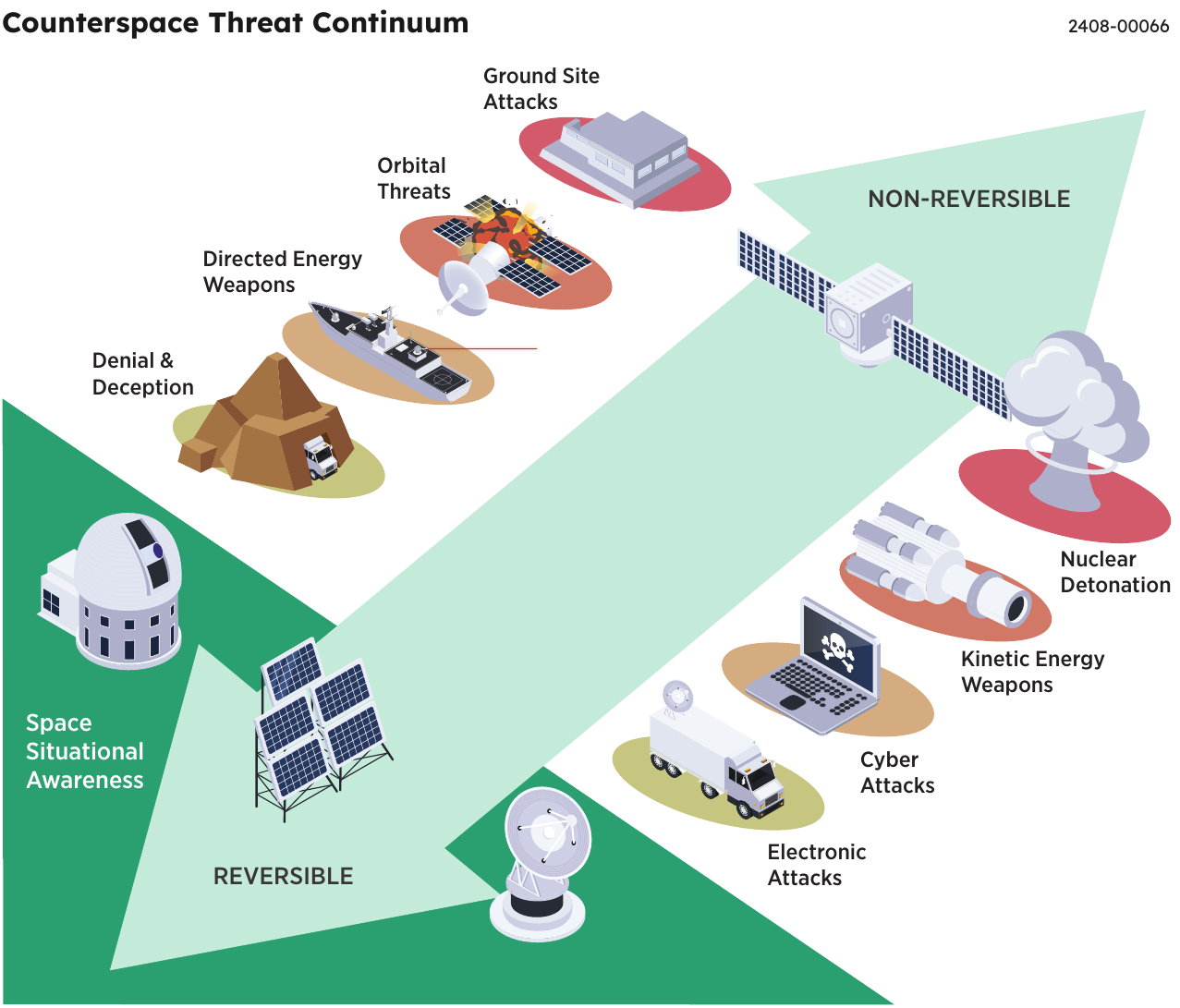
| Actor | What DIA reports | Pages |
|---|---|---|
| China | 510+ ISR satellites, tripled since 2018; LEO fleet can image any location in 30 minutes or less. Ground-based lasers that can disrupt, degrade, or damage LEO satellites; space-based directed energy possible by the late 2020s. ASAT missiles for low, medium, and high orbits. Robotic-arm and grappling satellites (Shijian-17, Shijian-21). Jammers aimed at SAR and SATCOM. | 20 to 27 |
| Russia | Nudol ASAT destroyed a satellite at 470 km in 2021, creating 1,700+ trackable pieces. Peresvet and Kalina lasers built to dazzle imaging satellites. Co-orbital satellites shadowing U.S. national security satellites, one within about 93 km. Burevestnik air-launched ASAT for LEO. A satellite designed to carry a nuclear weapon. | 39 to 42 |
| Iran | Land-based GPS jamming systems (Nazir, Fajr-3, Zolfaqar) and a growing satellite program. | 43 to 52 |
| North Korea | Military reconnaissance satellite (Malligyong-1) in LEO, with more reconnaissance launches directed by Kim. | 43 to 52 |
Three findings stand out for anyone building ISR in space:
- ISR is the target set. DIA notes directed-energy weapons can blind imagery satellites, “thereby denying the ability to monitor, track, and target forces” (p. 5).
- A nuclear detonation would be indiscriminate. Russia’s program could cause “rapid and sudden loss or degradation of thousands of satellites operated by countries and companies around the world” (p. 42).
- China’s ISR is aimed at U.S. forces. Its constellation “can be used to support global monitoring, tracking, and targeting of U.S. and allied forces worldwide” (p. 20), backed by relay satellites that move targeting data to operations centers.
Congestion and debris
DIA expects LEO to get more dangerous every year through at least 2040, driven by constellation growth and debris from past ASAT tests.
- Volume: more than 35,000 tracked objects of 10 cm or larger, plus an estimated 600,000 to 900,000 lethal nontrackable fragments in LEO (p. 55).
- Growth: planned large constellations “probably will triple the LEO spacecraft population” by 2030 (p. 55).
- Persistence: a collision at 975 km leaves fragments in orbit for more than a thousand years; objects near 1,500 km can stay over 10,000 years (p. 56).
- Self-inflicted damage: nearly half of LEO debris comes from three events: China’s 2007 ASAT test, the 2009 Iridium-Cosmos collision, and Russia’s 2021 Nudol test (p. 56).
- Cost: debris forces more fuel for avoidance maneuvers and more shielding on every satellite (p. 55).
“These events are of most concern in LEO where the highest rate of growth is predicted over the next decade.”
DIA, Challenges to Security in Space 2026, p. 57
What DIA says about VLEO
DIA treats VLEO (about 150 to 300 km) as a distinct operating layer with clear ISR advantages, and it flags China’s plan to field a large VLEO constellation by 2030.
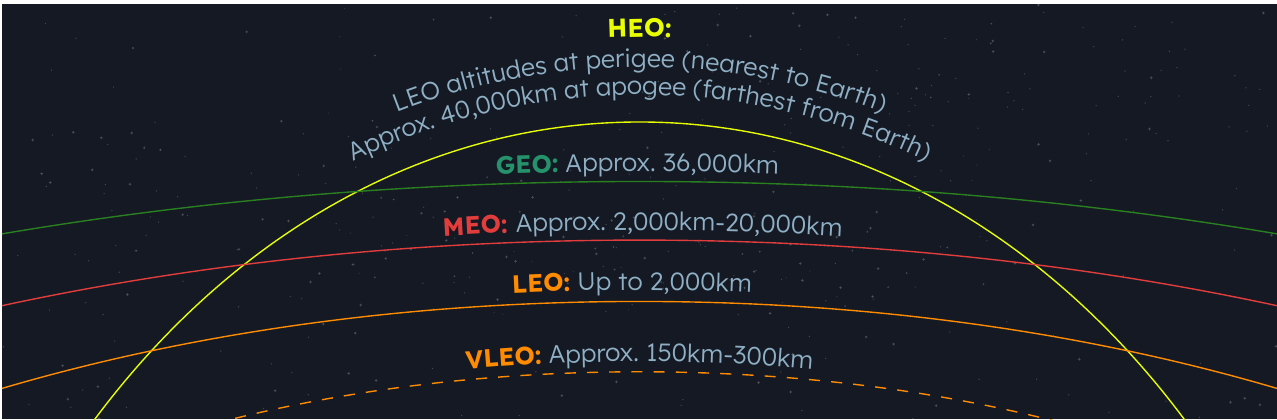
“Most satellites operate in orbits near Earth (i.e., LEO and VLEO) as being closer to the Earth lowers launch costs, increases imagery resolution, and decreases time between when a satellite is overhead.”
DIA, Challenges to Security in Space 2026, p. 2
On page 56, DIA lays out VLEO’s tradeoffs and the state of play:
- Advantages: lower payload power, more efficient data transfer to the ground, and optimal resolution from smaller imaging payloads.
- Self-clearing: atmospheric drag causes most debris at lower altitudes to reenter and burn up.
- Cost of entry: satellites spend more energy counteracting drag in the denser atmosphere.
- Who is investing: Japan, ESA, and private companies are running VLEO R&D for commercial, scientific, and national security purposes.
- China’s VLEO activity: C-Space launched the test satellite Qiankun 1 in 2023 to prove flight below 200 km. CASIC plans 300 Chutian satellites in VLEO by 2030, with half-meter imagery and a 10 to 15 minute response to an imaging request.
Problems and VLEO answers
Read together, DIA’s threat findings and its VLEO findings point the same way: a low, proliferated, replenishable layer answers several problems traditional orbits cannot. It does not answer all of them.
| Problem DIA identifies | What VLEO offers | Where it falls short |
|---|---|---|
| LEO congestion and collision risk rising through 2040 (p. 55) | Operates below the crowded shells; drag clears debris naturally (p. 56) | Satellites must spend energy fighting drag |
| ASAT debris lasting decades to centuries (pp. 5, 56) | Debris and dead satellites reenter quickly instead of lingering | Does not remove debris already in higher orbits |
| Kinetic and co-orbital attacks on a few high-value satellites (pp. 26 to 27, 41 to 42) | Smaller, cost-effective satellites in larger numbers make each loss less decisive and faster to replace | Still physically reachable by ground-launched ASAT missiles |
| Nuclear detonation degrading thousands of satellites (p. 42) | Cost-effective satellites can be reconstituted faster than exquisite assets | Lingering radiation belts would affect any orbit |
| China’s ISR tracking U.S. forces, with LEO imaging in 30 minutes or less (p. 20) | A U.S. layer with better resolution from smaller payloads and faster delivery (pp. 2, 56) | Advantage depends on fielding before Chutian in 2030 |
| Ground lasers that dazzle or damage imaging satellites (pp. 26, 40) | Numbers and fast refresh preserve coverage if individual satellites are dazzled | Closer range means VLEO is not shielded from lasers |
| Jamming of commercial SATCOM and SAR (pp. VII, 40) | Shorter links and efficient data transfer support resilient downlink options | Jamming remains a threat at every altitude |
The honest case is resilience, not invulnerability: VLEO shifts the balance toward numbers, replacement speed, and a clean orbit.
How DeepSat fills the need
DeepSat’s Orion’s Belt is a U.S. VLEO constellation at roughly 250 km, built around the gaps DIA describes: proliferated ISR, fast delivery, and an orbit that cleans itself.
| Gap in the DIA report | DeepSat’s answer |
|---|---|
| Few high-value satellites in a contested, congested layer | Many relatively inexpensive satellites on a 3 to 5 year refresh, replaced with upgraded sensors and compute instead of left on orbit |
| Debris and dead hardware that persist for centuries | Ion propulsion holds orbit; at end of life each satellite self-deorbits and burns up, leaving no debris and no hardware for an adversary to recover |
| China’s ISR lead and the 2030 Chutian timeline | VLEO resolution from COTS sensors that could not survive the radiation of higher orbits |
| Slow intelligence cycle: downlink, ground processing, then dissemination | NVIDIA GPUs onboard run detection, analysis, and chain of custody in orbit; optical backhaul delivers products in near real time instead of waiting for a ground pass |
| Disconnected systems across orbits | A relay and interconnect layer linking higher-orbit constellations to each other and to users, plus an upward-looking space domain awareness view |
DIA has documented that China sees VLEO’s value and is funding a 300-satellite answer.
DeepSat is building the U.S. one.
Source: Defense Intelligence Agency, Challenges to Security in Space 2026: Congestion, Competition, and Cooperation, and accompanying press release, Oct. 26, 2026. Page numbers follow the report’s printing; graphics from pp. 2 and 6.
About DeepSat
DeepSat is developing an advanced satellite constellation in very low Earth orbit (VLEO), combining high revisit rates with in-orbit AI for sensor fusion. The platform enables resilient, near-real-time, AI-powered Earth intelligence for critical missions such as vessel detection, energy infrastructure monitoring and disaster assessment across civil, commercial and defense.